
Make your important pages clearer, more relevant and easier to find.
On-page SEO helps make your important pages clearer, more relevant and easier to find.
Your website needs to do more than explain what your business does. Each important page should have a clear purpose, answer the questions your customers are asking and make it easy to understand what you offer.
Our on-page SEO work focuses on the parts of your pages that help create that connection, using search intent, relevant keywords, useful content and clear structure to help your website work harder.
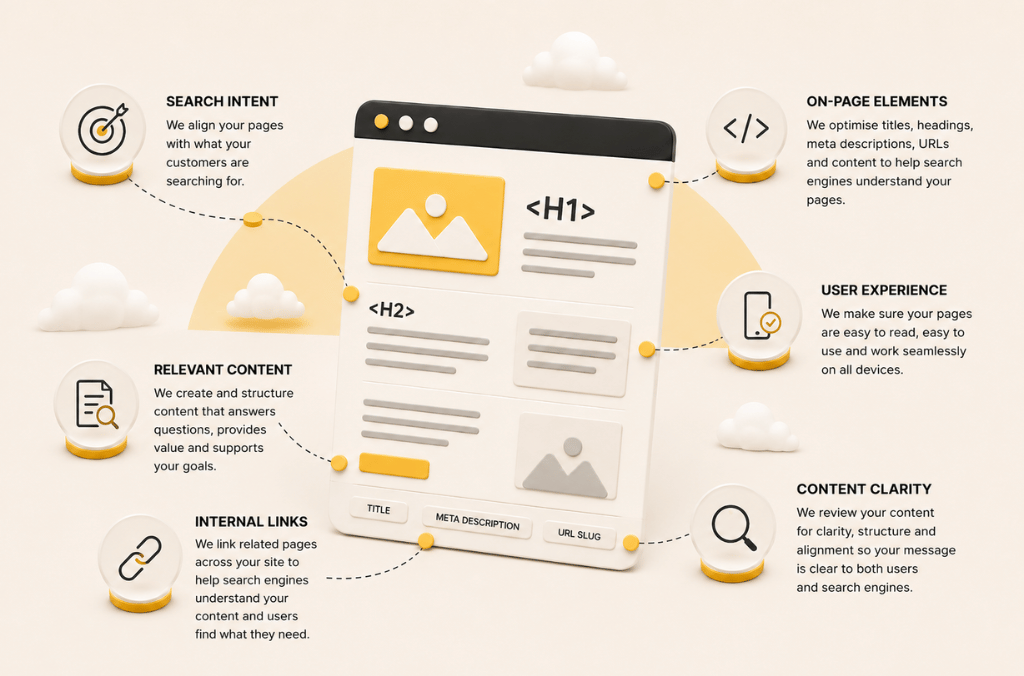
What is On-Page SEO?
On-page SEO is the process of improving the content and elements of individual website pages so they are clearer and more relevant to both search engines and the people using them.
That includes the information on the page, how it is organised, the topics it covers and how it connects with the rest of your website.
Good on-page SEO isn’t about adding keywords wherever they fit. It’s about making sure each page has a clear purpose and gives people a useful answer to what they came looking for.
When your pages are easier to understand, there’s a stronger foundation for search engines to connect them with relevant searches.
What goes into On-Page SEO?
Every website has different pages, priorities and opportunities. We look at the elements that can help your important pages communicate their purpose more clearly and better match what people are searching for.
1. Search intent
A page needs to answer the need behind the search, not simply contain the words someone typed into Google. We consider what people are actually trying to find, what information they expect and what type of content best meets that need. This helps ensure your pages are relevant to the search while still being useful to the person reading them.
2. Page titles and headings
Titles and headings help establish what a page is about and give people a clear way to move through the information. We review these elements to make sure they accurately represent the page, support its purpose and create a logical structure for the content.
3. Page content
Useful content needs to communicate more than a collection of keywords. We look at whether your pages clearly explain your services, answer relevant questions and provide enough useful information for someone to understand what you offer and decide what to do next.
4. Internal linking
Your pages don’t exist independently. Internal links help people move between related information and help search engines understand how different parts of your website connect. We look for opportunities to make those connections clearer and more useful.
5. Keyword relevance
Keywords help us understand how people search, but they aren’t the whole strategy. We consider the terms and topics that are relevant to each page and how naturally they fit into the content. The aim is to make the page relevant without compromising readability or forcing phrases where they don’t belong.
6. Page structure
The way information is arranged affects how easily someone can understand a page. We look at how the content is organised, how sections relate to one another and whether the most important information is easy to find.
On-Page SEO for service businesses
Service websites have a particular challenge. You need to explain what you do clearly enough for a potential customer to understand, while also making sure search engines can connect your pages with the searches that matter to your business.
A service page shouldn’t simply describe what you offer. It should reflect the questions your customers have, use language that makes sense to them and give them enough information to understand whether your business is right for what they need.
We can work across the pages that matter most to your business, from your core service pages to supporting content that helps build context around what you offer.
The goal isn’t to make every page longer. It’s to make every important page more useful and purposeful.
Your website should make sense to the person searching
Someone who lands on your website from search should be able to understand where they are, what the page is about and whether they’ve found what they’re looking for.
That sounds simple, but websites can become unclear as businesses grow. Services change, new pages are added and content gets written without always considering how everything fits together.
On-page SEO gives us an opportunity to look at those pages from the perspective of both the searcher and the search engine.
The result should be a website where important information is easier to understand, relevant pages support one another and your content reflects what your customers are actually looking for.
FAQs
Your questions, answered.
SEO can raise a lot of questions. Here are some of the ones we hear most often.
What is On-Page SEO?
On-page SEO is the process of improving the content and elements of individual website pages so they are more relevant, useful and understandable to both search engines and users.
What is included in an On-Page SEO service?
The exact work depends on your website and what we find. It can involve areas such as search intent, page content, headings, keyword relevance, internal linking and how information is structured across important pages.
Why is On-Page SEO important?
Your pages need to clearly communicate what your business offers and why they are relevant to particular searches. On-page SEO helps strengthen that connection and gives search engines and potential customers a clearer understanding of your content.
Does On-Page SEO mean adding more keywords?
No. Keywords are useful for understanding how people search, but effective on-page SEO is about relevance and usefulness rather than repeating the same phrase. The content should read naturally while clearly addressing the topic and intent behind the search.
Can you optimise existing website pages?
Yes. Existing pages can often provide valuable opportunities for improvement. We can assess what is already working, where the content could be clearer or more relevant and which pages would benefit most from optimisation.
How long does On-Page SEO take to work?
There isn’t a fixed timeframe. It depends on the current state of your website, the competitiveness of your market, the changes being made and how search engines respond over time. On-page improvements provide a stronger foundation, but SEO results develop over time.
Is your website making the most of its pages?
Let’s look at the pages that matter most to your business and where there may be opportunities to make them clearer, more relevant and more useful.